549 points by ireflect 8 hours ago
I'm in BC. The astro-nerd in me would have preferred to see permanent Standard Time instead of a permanent +1 offset. Instinctively, I think morning light is important to our biology for a daily reset and the solar cue of "high noon" is also a real thing. I'm sure I've read that sleep health experts have historically supported a change to permanent Standard Time, not DST.
I respect there are economic arguments for permanent DST. But I question the road safety stat I hear with announcements like this. Kids walking, biking, and being driven to school in mornings in darkness ... that's also what permanent DST gives us.
Oh well, I am in the minority it seems. So R.I.P. "high noon" ... I'll never see you again here. And, yes, I understand that depending on where one is within a time zone, a true "high noon" is only in theory. But it's a nice ideal. :-)
> Instinctively, I think morning light is important to our biology for a daily reset
I'd bet people would happily trade away the inkling of light they get during their winter commute before locking themselves into their office for some extra daylight when they leave that office.
Daylight is most enjoyable if you can actually make use of it.
That's what everyone says. But it turns out people hate spending their morning in darkness for more light at night. Which makes perfect sense:
https://washingtonian.com/2022/03/15/the-us-tried-permanent-...
> the inkling of light they get during their winter commute
It's not an inkling. Unless you roll out of bed and instantly onto your commute, you're getting natural sunlight through all your windows for hours every morning. That's exactly when you need it.
That has to be latitude dependent.
> you're getting natural sunlight through all your windows for hours every morning
Hah "hours". Not in Northern Europe you're not. My commute is dark on both sides. If I had to choose which side I'd prefer to be brighter I'd prefer the end of the day rather than feeling like my daylight has been wasted in the office. I shift my schedule in winter to make up for this as best I can.
I guess. I'm at 46 degrees and civil twilight at Christmas starts at 7am. I get up at 6:30, so yeah, dead of winter, I spend 30 minutes in darkness. But that's better than 1:30.
I guess it kinda hinges on this idea of "wasting" daylight. I don't feel like that. I want the sun to wake me up, and have no problem doing whatever I like when it's dark in the evening. Do people generally go on hikes after work? I go out for drinks. haha
56 degrees here (Denmark, and grew up in Ireland @ 53 degrees).
> I guess it kinda hinges on this idea of "wasting" daylight. I don't feel like that. I want the sun to wake me up
The problem is that during the darkest parts of winter, even if I postpone my wake up as long as possible, I'm still getting up in the dark if I want to be able to commute into work on time. There's no sunlight waking me up.
> Do people generally go on hikes after work? I go out for drinks. haha
No, but I still have to do things like walk the dog, do the shopping on the way home. I find it a lot more pleasant starting out that part of day with a bit of sunlight.
Also, yes, drinks. This is Northern Europe after all.
EDIT to add: Civil twilight in December where I am starts ~07:40, and I also get up around 06:30 (when not dealing with insomnia like tonight).
Why not just start school later?
> Unless you roll out of bed and instantly onto your commute, you're getting natural sunlight through all your windows for hours every morning.
Sadly, not if you're a student living in a basement in Vancouver!
> Vancouver
Southerners...
(Chiming in from Denmark)
Yeah I don't agree with this at all. I want the light when I'm getting up in the morning. When I'm coming home from work it's the end of the day: I'm tired, I'm hustling home to do errands or chores or make dinner, I'm probably going to spend that time inside anyway because that's where the things that I need to get done are, and if it it's going to be cold and windy, it's going to be cold and windy in the evening. I much much prefer daylight in the morning and I like when noon is actually noon (+/- depending on longitude). I'm not looking forward to the time change and I'm not looking forward to the sun setting at 9 PM.
If it wasn't for that damn 9 AM Monday meeting (ugh) I would just keep my clocks sent to standard time and start work an hour late in the summer.
> I want the light when I'm getting up in the morning
I apologize society is inconveniencing you.
interesting, I see his preference is some kind of slavering radical antisocial screed whereas yours is the universal desire of all of society
Kinda?
> In summer 2019, the Province conducted a public engagement on time observance that saw participation from a record 223,000 people, with 93% supporting adopting year-round DST. Similarly, across all industry groups and nearly all occupational groups, support for year-round DST observance was higher than 90%.
Well, I'm not one of those people. I like waking up with the sun and driving to work in the daylight. The idea that DST solves anything absolutely blows my mind. If you want the ability to start your work day earlier and end it earlier, that seems like a worker protection bill that needs to be passed. DST is the kludgiest kludge that ever kludged.
Where I live June sunrise (with DST) is 5:11am and sunset is 8:21pm (a city on the American east coast). I just can’t imagine a majority of people would want 4:11 rising and 7:21 setting.
In June, they wouldn't. That's why we currently change the clocks. But changing the clocks sucks, so you have to optimize for either the winter or the summer.
In the summer, we already have lots of sunlight regardless, so it doesn't make sense to optimize for that.
Winter sucks anyways when you live in the north. I grew up at 56 degrees north and you are cooked no matter what is done. Better to optimize April-October.
> If you want the ability to start your work day earlier and end it earlier, that seems like a worker protection bill that needs to be passed.
I don't think that's very realistic though is it? School times are fixed and that anchors a lot of families to those specific times, and businesses tend to have set hours.
Changing the time to give people more light in the evening frees up a bunch of people to enjoy some sunlight without making it a whole fight to have different hours at work.
School and the workday already awkwardly don't work together. Schools often end an hour or two after the traditional work day. It wouldn't be crazy to have an effective 'DST' via just adjusting the school start/end times -- start at 10am for part of the year dammit.
>If you want the ability to start your work day earlier and end it earlier, that seems like a worker protection bill that needs to be passed.
If that's what passes for aspiration these days then the labour movement truly is dead.
It's been dead ever since workers thought 40h work weeks and 2 weeks off a year was a good deal.
yeah im curious if people will end up liking it. sucks from my perspective.
The problem of offices is not when we spend time in them but rather that we spend time in them at all. What a banal hell it is we have consented to endure compared to the comforts of our homes or of any space actually designed for the wellness of human beings or even focused work.
Going outside for lunch is a great idea.
Time is an arbitrary construct in the sense that the mere lack of arbitrary change in time is a net benefit.
I.e., anyone who doesn’t like the change in either direction can just change schedules accordingly for business hours. Whether that means 8-4 or 9-5 or 10-6 is irrelevant. The fact that we would stop altering schedules twice a year is a positive.
Except for people like me who struggle to wake up before dawn. And whether people prefer light after work doesn't change the available scientific evidence which suggests there are significant negative health effects of waking up too early relative to sunrise, but no significant health benefits from having sunlight hours after work. People's preferences in this case are generally only mildly held and typically are not well informed by the science. I suspect if more people were aware of the deleterious health effects, their stated preferences would change.
Hell noooo. 4:30pm sunsets are ultra depressing in the winter. Less light in the morning is not at all a problem in comparison.
I've seen arguments about kids going to school in the darkness being thrown around a lot, but I've never understood why that (against fresh drivers) is always taken to be worse than kids coming home in the darkness (against exhausted drivers).
Average school start/end times in BC are 8:30 AM and 3 PM. Standard time in Vancouver puts sunrise/sunset at 8AM/415PM at winter solstice for standard time. That's 30 minutes of daylight before school and 75 minutes after school. IOW, kids are more likely to be walking in the dark in the morning, even with standard time.
Switching to daylight time will switch sunrise/sunset to 9AM/515PM, guaranteeing kids will be walking in the dark in the morning.
yeah the 4:15 PM sunset actually means it's getting dark at 3:30 PM. Pretty ridiculous. For everyone like "the kids have to walk to school in the dark!" it seems like they aren't considering that kids generally don't care at all what the morning is like because their day is about to be consumed by an obligation they never agreed to (school). When they're finally free for the day, it's effectively dark outside. The perspective among my peer group when I was a kid was that daylight savings system is totally clueless, has never made sense, and we should permanently switch to the schedule that allows more daylight after school (aka DST).
But we care about the kids. It's not about whether or not the kids are having a good time, but whether or not groggy people on their way to work can see them.
Would the better thing to do be to vary school hours by season? Add an hour in summer and remove an hour in winter?.
No school in summer.
When we start getting more sun, it’s fine in the morning even with the spring forward.
We go back to standard time in winter because otherwise it stays dark too long.
And all of this ignores the core fact that time zones are way more politically determined than geographically. And that’s a whole other problem
P.S.
Switching to daylight time makes more sense in Eastern BC than it does in Western BC. But Eastern BC is relatively unpopulated. The population of Penticton is 40,000 vs 3,000,000 in metro Vancouver. Second largest metro (Victoria) is west of Vancouver.
Penticton experiences sunrise/sunset about 25 minutes before Vancouver, so their kids experience approximately equal amounts of sun before & after school on the winter solstice.
I know exactly what you mean with your comment, but interesting fact, Vancouver is in the East of BC! BC is huge in both directions.
Even more so when you consider that most of metro Vancouver lives east of Vancouver city.
Move the school starts later. Problem solved.
if it ends up being an issue, then the schools could just change start time?
But that's the whole thing.
Why change the clocks when we could change the definition of school time, business hours, liquor/gambling licensing hours, construction noise hours, etc? Just use standard time and then base our society around the physics of the sun.
And if we do that, why can't we all just use unix time and let school can just atart whenever makes sense
One difference between morning and evening: in the mornings, some or even many students must wait outdoors for their bus to arrive, because they live too far away from the bus stop to run out when the bus pulls up. That means they are standing around in the darkness and the cold. In the evenings, they can go straight home from the bus.
I agree with you. I also need to shout at the clouds on this because the experts who make the argument for time changes drive me crazy.
I live in Calgary. At a previous grade school my daughter went to, school started early enough that she left in pitch black conditions in winter, regardless of "experts" and their precious daylight savings time.
'You need sunshine when you wake up' is really a ridiculous argument, there is no sunshine even with DST.
Get rid of it. Maybe egg the houses of the "experts" too.
(As for my kids, thankfully, they did remote school during Covid (hence late mornings) and then I moved to a place where the school starting time was later than 8.)
Yes, a lot of griping about "standard time" is really griping about winter. There are fewer hours of daylight in the winter. That's just the way it is. You can't fool time.
You can also just change the hours when things start without changing the clock for the entire country.
Anyone in the north has seen “winter hours” and “summer hours”.
> (against fresh drivers)
How many people roll out of bed, rush out the door and jump in the car before they're actually awake? In my circles, that would be a larger percentage that of those that get up with plenty of time to wake up. I'm not sure any time of the day is safer regarding attentive drivers. Especially if we're going to consider idiots on their phones while driving.
There is still a typical morning routine of an hour. How long do people need to wake up? If they are chronically tired is this going to get better through out the day?
Personally, I need multiple hours. I'm not the type to open my eyes, jump out of bed, and hit the floor running. I'm more the type of "fuck, why am I awake?" but then at the end of the day if there's stuff to do, I can be up for a while. So I'm much better at night than in the morning. Even if I'm my keyboard at 10am, I'm still not up to speed. My best comes later in the day. I think part of that is I've worked for places for so long that I was in meetings all day, and never got to do my actual job until late in the day when everyone else was winding down.
In addition to the reason already given (kids get home before the evening traffic picks up), another reason is that generally driving conditions are worse in the morning than they are in the evening so if there isn't enough light for both the morning and evening drives to be in light it is safer to give the light to the morning drive.
> another reason is that generally driving conditions are worse in the morning than they are in the evening
Wait, why? Where? I've never heard this. Which driving conditions are you talking about? Rain? Snow?
Generally the coldest part of the day is just after sunrise. The warmest part of the day is typically in the early afternoon, around 1-4 pm.
This makes a few driving hazards more likely or more intense in mornings, including fog, sleet, and ice. Also tires have less traction when they are colder. In the morning it is less likely for snowplows or earlier traffic to have cleared paths on secondary roads.
Driver assist systems tend to have more trouble with sensor fogging, frosting, or icing in the morning.
That's not to say evening is a piece of cake. Evening tends to have denser traffic which increases the risk of accidents. Places that are in shadow for much of the day might maintain ice while most of the morning ice melts, or might start developing new evening ice earlier than places the heated up more in the day which could be particularly bad--if most of the road is ice free in the evening people might let down their guard.
It's coldest at night, so morning ice would be worse than evening, when daily highs are reaches and roads have been driven on more.
> kids get home before the evening traffic picks up
When we change the general time, this applies to school days as well as office hours, so the kids go home to evening traffic relation will stay constant.
> kids coming home in the darkness (against exhausted drivers).
If you’re exhausted you shouldn’t be driving. Period. You’re the danger to kids, not light or darkness. (Your headlights are in working order, right?)
Nice sentiment, sadly we live in the real world
I grew up in an area outside the US, and quite a bit more to the north. I still remember how for several weeks each year I had to walk to school in the dark, sometimes having issues with seeing where I was walking.
The DST changes abruptly made everything visible again. Around that time we were also getting a permanent snow cover. And the whiteness of the snow significantly improved visibility for the rest of the winter.
So I don't think that the concerns are completely unfounded, but they are probably not as dire either.
Am I missing something? DST will make walking to school in the darkness more likely, not less.
DST means a later sunrise.
> I've seen arguments about kids going to school in the darkness being thrown around a lot
I’m sure there’s some correlation with the time zone, but it feels like a “think of the children!” argument that ignores much more significant factors (e.g. traffic speed and volume).
Everytime people extoll the virtues of high noon, I ask the same question: why does it matter if the sun reaches it highest point near 12 o' clock? You're awake for 4-6 hours before 12, and you remain awake for 10-12 hours after it. Noon isn't the middle of the day for nearly anyone in the western world.
I understand the argument for having an early sunset, clearly having sunlight when you're awake has an effect. But who cares about having an early high noon, when there's still two thirds of the day left at best?
I'm a relatively early riser, but: if you steal an hour of my summer evening time, I think that would call for civil unrest.
What time the clock says shouldn't affect this
About 50% of people want permanent standard time, 50% want permanent DST, 50% want to keep time changes. Doesn't add up? That's the point.
Everyone finds arguments that suits them. Some will quote "sleep experts", others will mention economic reasons, others will talk about road safety, each one with studies proving their point, peer-reviewed for the most sophisticated.
My take is that we are all different, and whatever you choose, some people will be better off, others will be worse off. There is a high chance that that variety is an evolutionary advantage, at least it was for our ancestors, as a group where everyone is sleeping at the same time is more vulnerable. Not great for office hours though.
> I'm in BC. The astro-nerd in me would have preferred to see permanent Standard Time instead of a permanent +1 offset.
So would the folks who study circadian rhythms:
> Over much of the highly-populated areas of Canada, the sun would not rise until about 9 am in winter under DST, and the daylight will linger an hour later in summer evenings than under Standard Time. As a Northern country, Canada includes higher latitudes where the effects of late winter dawns and late summer dusks under DST would be felt more profoundly. What long-term effects on health can we expect from year-round DST? As predicted from our understanding of the human biological clock, our brain clock will try to synchronize to dawn and push us to go to bed later. However, our social clock will force us to wake an hour earlier in the morning. Will this have any health effects?
> We have good evidence for the negative impact of being an hour off of biological time, and this comes from studies on the health of populations living on the edges of time zones. We have arbitrarily divided the earth into one-hour time zones, so that people on the east side of a time zone see the sun rise an hour earlier (according to their social clocks) than people on the west side of the same time zone. Researchers have analyzed the health records and economic status of those two populations, and have found poorer health outcomes on the west side: increased rates of obesity and diabetes, heart disease, and cancer (Gu et al., 2017). Moreover, people on the west sides of time zones earned 3% less in per capita income (Giuntella and Mazzonna, 2019). What could account for this? As predicted, people on the west sides of time zones go to bed later than people on the east sides, but then have to get up at the same time in the morning because of fixed work and school schedules. Therefore they lose sleep: about 20 minutes per weeknight, which adds up to a significant sleep debt over the week. We know from other research that sleep deprivation negatively impacts health and workplace performance. We can already see the negative impacts of a one-hour difference across a time zone, and year-round DST would put our social clocks another hour out of alignment with our biological clocks.
I guess northern Europe must be an unpopulated wasteland where everybody's health just instantly declines.
I find these explanations to these studies so bizarre. We know that there are large populations living significantly further north, who don't get sunlight in the morning in winter, no matter whether there's DST or not. We also know that they get almost perpetual light during summer. If these explanations were true then you would expect a country like Sweden to have an impact on life expectancy and illness from this. But it's not. It's about as rich as Canada and has about the same life expectancy.
The European Biological Rhythms Society (EBRS), European Sleep Research Society (ESRS), and Society for Research on Biological Rhythms (SRBR) put out a joint statement that recommends all-year Standard Time in the EU:
* https://esrs.eu/wp-content/uploads/2019/03/To_the_EU_Commiss...
I would hazard to guess some of those folks have looked at data for northern Europe and took it into account when forming their conclusions.
I live in the Yukon so will now be in sync with BC time again after this change. The concerns about commuting to school in the dark seem almost comical, given the experiences of everybody here with the winter darkness.
For other reasons, I also wish we were closer to solar noon though. High noon is actually closer to 2pm here and seems to push the whole day back in the summer. The best (warmest) parts of the day get pushed too late into the afternoon.
+0 vs +1 boils down to dropping kids off vs shopping.
I live a bit north of Whistler. BC is rather larger than the UK but it is very roughly the same in north/south extent. Yeovil (Somerset) is about the same lat as Calgary, next door to you.
Unfortunately we live on an oblate spheroid what spins around the sun and its a bit tricky when the sun comes on and is switched off. It doesn't help that the basted planet is tilted to the ecliptic too so we end up with daylight/nighttime procession and all that equinox/solstice bollocks. I live quite close to both Glastonbury and Stonehenge. People have some pretty odd ideas about reality, let alone time in these parts 8)
The "perfect" solution is of course moving the clock continuously and keeping 12:00 fixed to peak daylight. Sadly that wont work too well when the time changes every 50 miles or so!
No one will ever be happy when it comes to fiddling with clocks - that is the way of life. There is no right answer for everyone and never will be. I might accept an arguement based on road fatality statistics but not much else and then you'll get some sort of economic based falacy in response.
100% with you.
And every argument I hear from the pro DST group is really just an argument for ending adult work at 15.30 rather than 17.00 and maintaining a 9.00 start time.
It blows my mind that we are all meant to wrap our lives around bullshit jobs.
Same, also in BC.
I agree with everything you write, and in principle I'd prefer just to stay on standard time forever.
However for my selfish individual interests: I work with a lot of people in Europe, and this change to permanent DST will make the time difference once hour less for 4 months a year… until the rest of the world goes this way too, at least.
> Oh well, I am in the minority it seems.
Given it one winter season across the solstice and I'd bet a lot of your fellow residents will come around to your viewpoint.
I'm really curious how people will feel about it after experiencing a year of continuous PDT. I expect I'll personally like it, but the polling will be interesting for sure.
In the winter I can see arguments both ways (though I'm personally in the evening light is better camp). But in the summer, it already gets light earlier than almost anyone would want to be awake. An extra hour of sunlight at 4am is little benefit to anyone, and likely just makes it harder to sleep. Light evenings in the summer are wonderful though. I think part of the health argument against DST is that those light evenings make it harder to get to sleep at night, which is fair, but I still wouldn't want to give them up!
Can't you just get up at a different time if you prefer different sunlight?
Will all jobs, schools, stores, etc also change their working hours?
Usually there are several hours of reasonable buffer in the morning. We're only talking about moving wakeup time by one hour here.
That massively depends on where you live. The northern most city of British Columbia is Atlin and during some parts of the year the sun doesn't rise until 9:54 AM.
If you take into account places further north than British Columbia it gets even more extreme. Barrows Alaska has the sunrise after 1 PM some days. Do you think businesses, schools, etc are going to start at 1 PM on those days?
Seems dumb that we change the time to an offset rather than changing from 9 to 5 to 8 to 4.
I don't get why we just don't cut it down the middle. Go +0.5 offset and get a little bit of both. Love the idea of no one being able to do the math when talking to people outside the province. I can't tell you what time it is in mountain time, NFLD, or Saskatchewan. Nothing bad comes of it.
Or just have schools change their hours as needed.
Time changes are just a hack to make every business change their effective office hours back when the sign on the door - and coordination - mattered. Today brick and mortar is way less relevant. Way more people are working from home or going to work at random hours. The time change doesn't affect going to grocery store or restaurants or the gym. It's basically just schools, banks, and the DMV.
Why not have a given entity change its hours through the year, if the relation to the sun actually matters?
(And no, I don't buy that there needs to be time coordination between schools, since they are all already slightly different anyway. Different kids have different after school programs different days. Different parents are already going to work different hours. There's no way to coordinate for everyone to be happy, ever.)
No one wants another Indian time zone in the world - one is already enough of a hassle to deal with.
> Kids walking, biking, and being driven to school in mornings in darkness.
It's not 1900s anymore. Cars have fancy headlights and sensor suites for AEB. And generally street lighting is available around schools.
just move it by .5 permanently
Thankfully, this is a situation we don't need to speculate about without evidence. Spain is on de facto permanent DST, serving as a natural experiment. I bet the results support you.
That's partly because it's in the same timezone as Poland. Madrid is further west that London, but London is an hour behind. Moving Spain to permanent DST puts it on the same effective timezone as London.
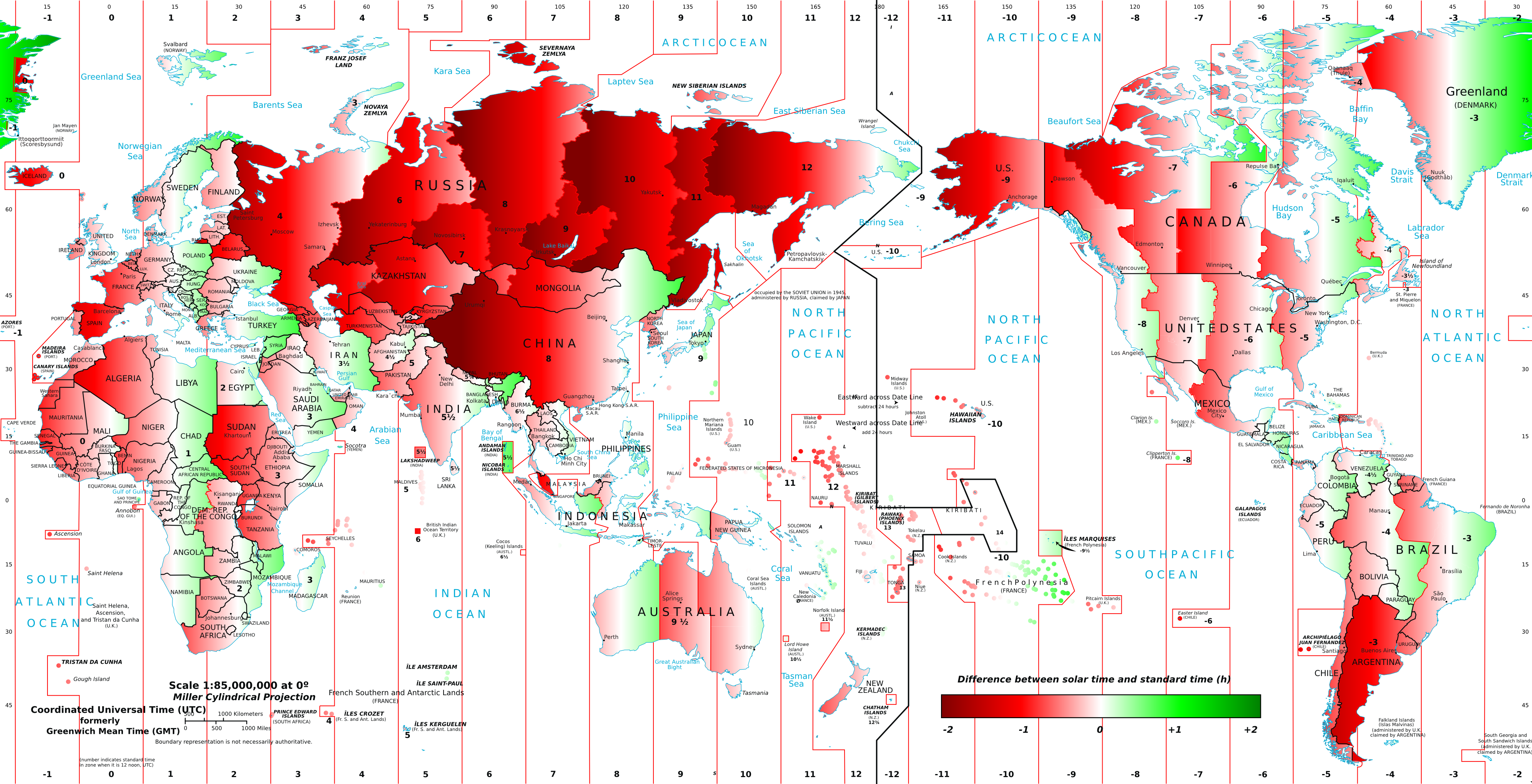
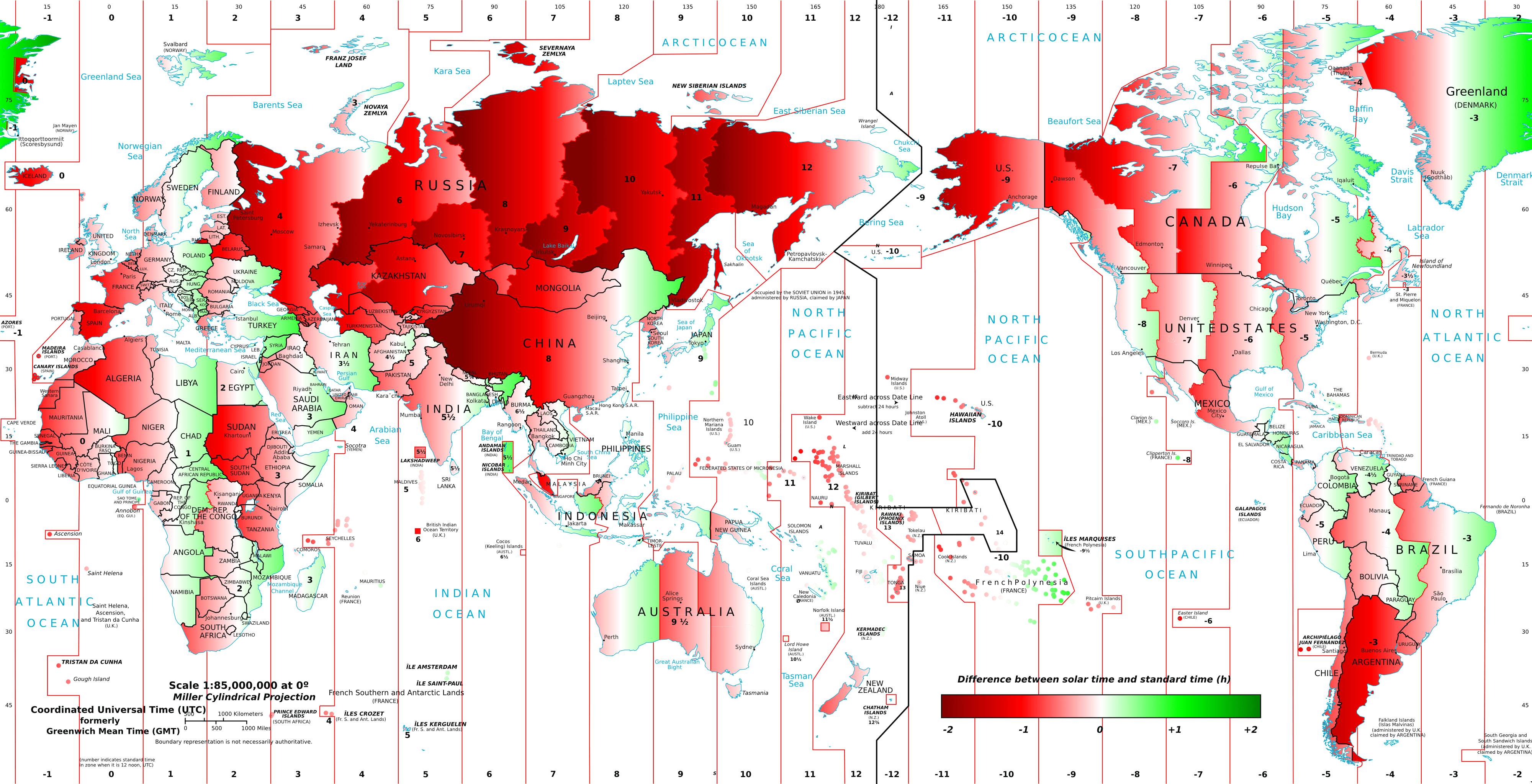
http://blog.poormansmath.net/images/SolarTimeVsStandardTime....
Without the DST offset, Spain much more "red" than England.
It's not so much a "permeant DST" but rather a "we want to change to GMT without moving out of the CET timezone."
That map is interesting, so most of the world prefers "red" to "green"? Why is that?
Most of the world tends to prefer to not be too far from the center of the timezone (where solar noon matches solar time in standard time). Geographic and political boundaries make it so that often it's more red. The extremes of north and south tend not to care as much because it doesn't matter as much.
https://andywoodruff.com/blog/where-to-hate-daylight-saving-...
I don't think that explains it. The "red" offenders are basically Russia, China?, Sudan, Argentina and Alaska. The only "green" offender is Greenland, which is still large enough to enough red to justify it. I get China, it aligns with the population density. Sudan likely wants to have the same time as Somalia and Ethiopia. Why Argentina? Why Alaska? And why does Russia basically have zones that range from +2 to the +1 offset? They don't even have the excuse of avoiding 2 hour jumps like between Alaska and Canada, because they still have that.
I'd have to dig to try to find out what the date on this would be.
Russia is telling since they changed their timezones in 2016. I'm going to note that timezones are also a political identity too. https://www.timeanddate.com/news/time/russia-new-time-zones.... For a map https://commons.wikimedia.org/wiki/File:Difference_between_l... and the Wiki article https://en.wikipedia.org/wiki/Time_in_Russia#Russian_Federat...
China is aligned with Beijing and the rest of the country follows from when noon in Beijing is.
Sudan's history is in https://en.wikipedia.org/wiki/Time_in_Sudan
Argentina is https://en.wikipedia.org/wiki/Time_in_Argentina - My speculation would be that Argentina (the east coast especially) wanted to be economically synchronized with the coastal cities of eastern Brazil. Buenos Aires and São Paulo being on the same timezone makes it easier for the two of them to do business.
Alaska used to have four timezones. In 1983, they were consolidated into two timezones - Aleutian and Alaska. Being in -9 rather than -10 brings Anchorage closer to the Pacific west coast in its business day with the note that it doesn't matter too much when solar noon is if sun is up for 22 hours or 5 hours.
In Poland in winter it gets dark around 3 PM. Awful. In Spain in winter it gets dark around 5:45 pm. And people wonder why spaniards live longer.
The clocks should show 4:45PM in Spain if the TZ was right (same as UK), and even so it would still be mostly red-white with barely any green. Poland appears white-green in the map, to have a bit of red it should be in a 1/2 TZ like India.
Minimum daylight (winter) in Warsaw is 7h 42m [0] and in Madrid 9h 17m [1]. Maximum (summer) is 16h 47m and 15h 4m. That is due to latitude and unavoidable. The exact numbers for sunset and sunrise are pushed around by the TZ choices.
[0] https://www.timeanddate.com/sun/poland/warsaw
[1] https://www.timeanddate.com/sun/spain/madrid
Life lenght depends on many factors.
Spain instead adjusted it's entire country around the time.
And they still do DST. They're just on a different time zone than they should be because during WWII, they changed to the same time zone as Germany.
Spaniards are a lazy bunch of party animals, waking up late and going to sleep late too...
Or the clocks are wrong. Once you realize noon is 13h in winter and 14h in summer, never 12h, things start to make sense. Late lunch? Not really, Sun at same height than Italy, but clocks off by 1.
For the "public image" part of the experiment, the conclusion is easy: bad. Time to change clocks so waking up happens at "3h" in the morning, and become a country of hard workers with no nightlife, because everyone retires "early". Even if discos are full as in the past.
If you have a problem with school start times, you could also just change school start times.
Why now? From the Govt of BC press release: "The Interpretation Amendment Act, which is the legal framework that enables the Province to adopt permanent DST, became law in 2019. At the time, government chose not to bring it into force in order to co-ordinate timing with neighbouring U.S. states in the same time zone.
Recent actions from the U.S. have shifted how B.C. approaches decisions that merit alignment, including on time zones. Making this change now reflects the current preferences and needs of British Columbians, and helps ensure the province is well-positioned to thrive, even when circumstances across the border evolve."
Notably Washington state legislated the same change to DST years ago (instead of standard time, the morons!) but the federal government never approved the switch. AFAIK it's still pending. I remain unclear what authority the federal government has over such a matter and why Washington (or any other) state has opted to respect it. What are they going to do if a state just ignores them and switches their clocks?
Sometimes I get the impression that the spirit of states rights in the US has died.
> I remain unclear what authority the federal government has over such a matter
It's actually an enumerated power under Article I, Section 8, Clause 5:
> [The Congress shall have Power...] To coin Money, regulate the Value thereof, and of foreign Coin, and fix the Standard of Weights and Measures; ...
https://constitution.congress.gov/browse/essay/artI-S8-C5-1/...
I'm surprised that would be interpreted to include time zones. Units of time, arguably (measures), but time zones? Time zones are not a measure of anything. Time zones do not follow on from definitions of units of time, any more than road speed limits follow on from the definition of a mile.
I would be less surprised if it were the commerce power used to uphold time zone coordination - for the promotion and regularity of interstate commerce etc etc. Tenuous, but consistent with a lot of the other nonsense that's been hung from the commerce power over the years.
Then there's the actual enforcement angle - time zones are just a social convention whereby people in a given area pretend that the time is slightly different than it 'really' is (local solar time). There's no reason local / state government and businesses can't post / operate on different hours, and leave federal bodies to operate on whatever 'federal time' they want. This already happens in parts of the world where the official time is locally inappropriate, such as Eucla in Australia or Xinjiang in China.
Obviously the optimal solution here is to coordinate a time change at all levels of government, but failing that there are other options.
If US states want to get rid of time switches they are free to go to year-round Standard Time (like Arizona).
Just switch to the +1 standard time. WA can switch to MST, which is equivalent to PDT.
It still requires federal approval, but from Sec Transit instead of Congress
You're saying the federal government granted blanket authorization to switch to the one? So the only reason states wait on authorization is merely obtusely insisting on the wrong choice? (In addition to being impotent.) The more I learn about this issue the more things I find to be angry about.
Permanent DST being the "wrong" choice is your opinion, and a minority one. Certainly doesn't make those who disagree "morons".
Indeed, it is my opinion. It's not in the minority so much as it runs counter to what lobbyists with vested interests have loudly promoted. Most people haven't given the matter much thought and don't have an opinion on it (let alone an informed one).
"Morons" was an overly dramatic way of putting it but it is very clearly the technically deficient choice as will be apparent to anyone who bothers to consult the history books. The US already attempted permanent DST in 1974 but quickly repealed it. Russia similarly tried it out from 2011 to 2014 before switching to permanent standard time instead. The UK also tried it at one point before abandoning it. Mexico might have tried it for the longest, from 1996 until 2022 when they too switched to permanent standard time. (Actually I'm unclear why Mexico gave it up. They're far enough south that the difference between the two shouldn't be particularly impactful.)
The correct answer here is obvious. (This being HN I guess personal political rants aren't really the thing to do so I should at least link to some actual literature on the topic. https://www.frontiersin.org/journals/physiology/articles/10....)
> Permanent DST being the "wrong" choice is your opinion, and a minority one.
It is the majority opinion of people that study chronobiology (circadian rhythms) and sleep researchers, as issued via their professional societies:
* https://srbr.org/wp-content/uploads/2018/10/SRBR-Statement-o...
* http://www.chronobiocanada.com/official-statements
* https://sleepresearchsociety.org/wp-content/uploads/2022/11/...
* https://jcsm.aasm.org/doi/10.5664/jcsm.8780
* https://www.frontiersin.org/articles/10.3389/fphys.2019.0094...
* https://pubmed.ncbi.nlm.nih.gov/35382618/
* https://journals.sagepub.com/doi/full/10.1177/07487304198541...
* https://www.ama-assn.org/public-health/prevention-wellness/s...
* https://esrs.eu/wp-content/uploads/2019/03/To_the_EU_Commiss...
From a public health perspective, all-year DST is not good, and all-year Standard Time is what should be done.
Yes. States are allowed to ignore "summer time" and remain on "standard time" all year round. Arizona is the usual example cited, they do not change the clocks, and remain on standard time year round.
The special auth. from the Fed's is needed to switch to "permanent summer time" (and, possibly advocating for year round "summer time" gives the state politicians cover to do nothing, because "their hands are tied...").
I read elsewhere this may be partial reason why BC forged ahead. As Canada/US relationship is on the rocks and BC stopped waiting for the US to change.
Nailed it. It's been ~5 years, and the odds of coordinating with the US grow smaller by the month.
It is crazy, because there is actually a law that allows us to switch to year round PST if we want (but no one wants that), while we need congressional approval to switch to PDT year round (which is what everyone wants) and the house voted for it, but the senate simply didn't make it a priority.
[flagged]
Could you please stop posting unsubstantive comments and flamebait? You've unfortunately been doing it repeatedly. It's not what this site is for, and destroys what it is for.
If you wouldn't mind reviewing https://news.ycombinator.com/newsguidelines.html and taking the intended spirit of the site more to heart, we'd be grateful.
We've already had to ask you this recently so it would be good to fix. I don't want to ban you - your good comments are fine. But bad comments do more damage than good comments add goodness... a sad fact of life.
It was only ever a thing to promote civil war grievances.
> Sometimes I get the impression that the spirit of states rights in the US has died.
It was bullshit from day one. The origin of the state's rights argument was slave state's attempting to force free states to round up fugitive slave and return them to the slave states.
Ha! I read the news and I was wondering if the scuffle with the US was the nudge to get this going, further differentiating the way of life.
My intuition was correct
pats own back
I would have preferred permanent standard time to permanent daylight time. But I accept I'm in the minority, and even permanent daylight time is far superior to changing clocks twice a year.
It's "standard" for a reason. Humanity settled on these numbers long ago because they work best. It boggles my mind why anyone would choose otherwise since what we do at any given hour is arbitrary.
A lot of people hate standard time in winter because the sun sets at 4 or 5, and they want the sun to instead set at 8 or 9 like it does in summer. DST in winter doesn't actually give you the 8 or 9 sunset, it gives you a 5 or 6 sunset (which doesn't get you all that much) combined with moving your sunrise to 8 or 9, which causes its own set of issues most people don't think about.
The last time we went to year-round DST, we stopped almost immediately because people experienced what winter DST was actually like and went "wait, this sucks."
Obviously(/s) the solution is to change to a sunset centered day. new day starts at sunset so people can get up late and enjoy the maxim number of daylight hours.
I always find it strange how particular people are about the numbers attached a purely astronomical phenomena(myself included, but I am pretty hard in the "let the sun figure it out camp"). If they want more "daylight" hours then get up at a time to enjoy them. But people would rather bend over backwards fiddling with the numbers as if that is going to change how long a day is.
The problem is that work does its best to capture all of my daylight hours.
Does the night belong to the day it follows or the day it precedes?
Does it become Friday at dawn, at sunset, at noon, or at midnight?
This is all convention and not something that can be decided objectively.
I think that midnight should be around current 4AM because that's the brief moment when party people already sleep and work people aren't awake yet.
No, I hate standard time, because in winter the sun sets at 4 or 5, when it could set at 5 or 6, i.e. daylight when leaving work.
I do not care if the sun is up as I shuffle groggily into the building. I don't think I'm alone.
The main driver of people wanting year round DST is so they can have sunlight after work in the winter. Those late sunsets in the summer are awesome too though.
Despite all this I am a permanent DST fan. However I’ll be happy with permanent anything over the current madness
> which doesn't get you all that much
After college I moved from the far western edge of one timezone to the far eastern edge of another zone. I grew up with 5-5:30pm sunsets in winter, and now I live with 4-4:30pm sunsets. I moved here 25 years ago, and every single year when November/December come around and I get those early sunsets I hate it. It's one of the reasons I'd like to move away from here.
I know it's just one person's opinion, but to me those extremely early sunsets in the middle of winter are a huge quality of life reduction.
I believe part of the problem is that if you're in the middle or western edge of your zone, the winter sunsets aren't so bad. I suspect a lot of people who would prefer DST year round live on the eastern edge.
They worked best when everybody were farmers and had to get up early and go to bed early. Now most people don't live their lives centered around noon, our free time comes after our work is done at around 17:00, so having more light in the evening instead of worthless light in the night makes sense.
That's a myth.
Farmers have to wake up early because their animals wake up at sunrise and some tasks are best performed at that time. So they wake up before sunrise regardless of the clock time.
Human, like farm animals, are better off if they wake up at sunrise and go to sleep in full dark. At the equator that's easy, wake at 6, bed at 10PM. And standard work hours are 7-3 or 8-4.
Right, but where I live sunrise is in the middle of the night in the summer (around 03:30). Using standard time in the summer gives me one less hour of useful sunlight in the evening, and while it doesn't technically disappear it gets moved to where I can't use it because that's when I sleep. It's the same for people further south as well, another bright hour in the early morning before they wake up is a wasted bright hour that would make more sense in the evening, when most modern humans are awake. The argument "noon should coincide with solar noon" is nonsensical to me, the clock is a social construct and should make sense for how most of us live our lives.
But the social construct of work hours shifted later by more than that one hour during the last century, so this is not what people actually prefer by their actions.
Optimizing for summer is silly. Summer gets lots of daylight already. We need to optimize for winter.
People disagree on whether to prioritize mornings or afternoons in the winter. For the summer, only very few people care if the sun rises at four or five (or whatever), but most people like having long summer evenings. Therefore the summer tips the scales.
Then they are also social activities that you just need to wait for in summer, because they can only happen after sunset. Viewing a movie (outside), sitting around a fire, having a party all just really happen after sunset.
So, it sounds like you're actually arguing that the numbers are just a construct and that we should all just use UTC and set appropriate work hours to the times that most correlate to the solar day in our region rather than adjust the clock approximately 1 hour per 15 degrees around the equator and have an International Date Line.
I think this would make way more sense, when they say the Olympic Opening Ceremony start at 18:00, its 18:00 for everyone around the world. No one as to work out which TZ Italy is in or scheduling meetings with Tech Support in far flung locales does not require knowing IST is how far ahead or behind.
Yes. https://en.wikipedia.org/wiki/Sandford_Fleming ( https://www.smithsonianmag.com/smithsonian-institution/sandf... )
> He promoted worldwide standard time zones, a prime meridian, and use of the 24-hour clock as key elements to communicating the accurate time, all of which influenced the creation of Coordinated Universal Time.
The one bit where this would be problematic would be "what day is it?" When does today become tomorrow?
There are a lot of systems that we've built that depend on that distinction. Things like business days and running end of day so that everything that happens on March 2nd is logged as March 2nd. I've encountered fun with Black Friday sales where the store is open over the midnight boundary and the backend system really wants today to be today rather than yesterday (sometimes this has involved unplugging a register from the network so that it doesn't run end of day, running EOD on the store systems, and then plugging the register back in after it completes and then running a reconciliation.).
Other than that particular mess of banks and businesses... yea, running everything on UTC would be something nice in today's world.
---
This is also kind of what happens in China (with a complicated history). https://github.com/eggert/tz/blob/main/asia#L272
https://en.wikipedia.org/wiki/Time_in_China UTC+08:00 is observed throughout the country even though it spans about 60° of longitude.
---
Aside on the "changing clocks" and realizing my flexible schedule privilege at a company I worked at I switched my schedule from 8-4 to 9-5 with the change in daylight savings so that I maintained a consistent "this is the hour I wake up".
> arguing that the numbers are just a construct
Yes.
> and that we should all just use UTC and ...
No. that does not follow. Abstraction is useful. Having commonly understood terms (in this case hours of the day) that share certain traits regardless of where you happen to be in the world facilitates communication.
We don't use standard time because it works best, we use it because it's "correct" relative to the position of the sun.
Now, standard business hours (9-5 or whatever) were probably chosen for working well in the circumstances where they became standard, and it might be interesting to watch for whether tweaking the clocks leads to tweaking the nominal time of things...
The US decided (and Canada followed) that daylight time was more correct for the larger portion of the year, presumably it's easier to transition the remaining 4mo to daylight than it is to move 8mo to standard.
But also, all the opinion polling (business and individual) was like over 90% in favour of year-round daylight time, so here we are.
> The US decided (and Canada followed) that daylight time was more correct for the larger portion of the year, presumably it's easier to transition the remaining 4mo to daylight than it is to move 8mo to standard.
How is transitioning permanently to one easier than transitioning permanently to the other?
How to transition to permanent DST: wait until we are in DST and then stop switching.
How to transition to permanent Standard time: wait until we are in standard time and then stop switching.
If you adopt permanent DST, the there's a 1 hour difference between the current clock and the future clock for 4 months, and nothing for 8 months. If you adopt permanent ST, the difference between the current clock and future clock is 1 hour for 8 months and nothing for 4 months.
It's a 4 month-hour difference over the year, instead of an 8 month-hour difference.
Personally, I'd prefer standard time, but having all days be 86400 seconds is a pretty great improvement over status quo. I find what most people really would like to change is the amount of time with sunlight in the winter, especially the more north they live... but changing the clock doesn't change the number of hours of sunlight; Vancouver, BC just doesn't have much sunlight in the winter.
If we assume that the ideal time for 8 months of the year is DST and for 4 months is standard, but we want to eliminate the switch, then permanent DST gives you only 4 months out of the ideal timezone rather than 8.
> It's "standard" for a reason
The reason is that with standard time, solar noon coincides with local noon, so the day is approximately symmetric about noon, not regarding atmospheric refraction lengthening the day. It wasn't done on a whim.
The article, however, says 93% wanted daylight savings in the linked public engagement report.
I’d guess that there is less of a need for light at the beginning of the day since most people don’t farm. Personally I prefer more light at the end of the day.
I don't get that argument. The numeric time is just a measure for the state of the sun in the sky. When you choose your day to have ended is completely independent. There is already a high enough variance of people deciding when they go to sleep, that DST is hardly relevant. Some people have dinner at half past 5, some do at half past 8, the hour daylight saving time can't possibly make that difference.
Exactly, here in Spain we have lunch between half past 2 and half past 3 on workdays, which can extend up to 5pm in the weekend and I usually finish dinner at half past ten.
Why? because they decided to be on the same timezone as our eastern neighbors in Europe. The eastern part of Polonia is on the same timezone and probably have probably the opposite with much much earlier lunch and dinner than we do.
The timezone centered across Görlitz made a lot of sense for the German empire, because it was nearly in half longitude wise and 15° away from Greenwich. It is still somewhat centered in Europe. If you wanted to divide it again, you would need to decide whether the border should be between Germany and France or France and Spain. If you place it between Germany and France, which side will the BeNeLux countries be on? France still has some parts that are nominally in +1 and we don't want to disturb the German-French "friendship", so maybe place it between Spain and France, where there is at least a mountain border? Would that be acceptable? Railways connections between Spain and France are also much less and concentrated than between Germany and France.
-----
https://vividmaps.com/wp-content/uploads/2024/02/time-zones-...
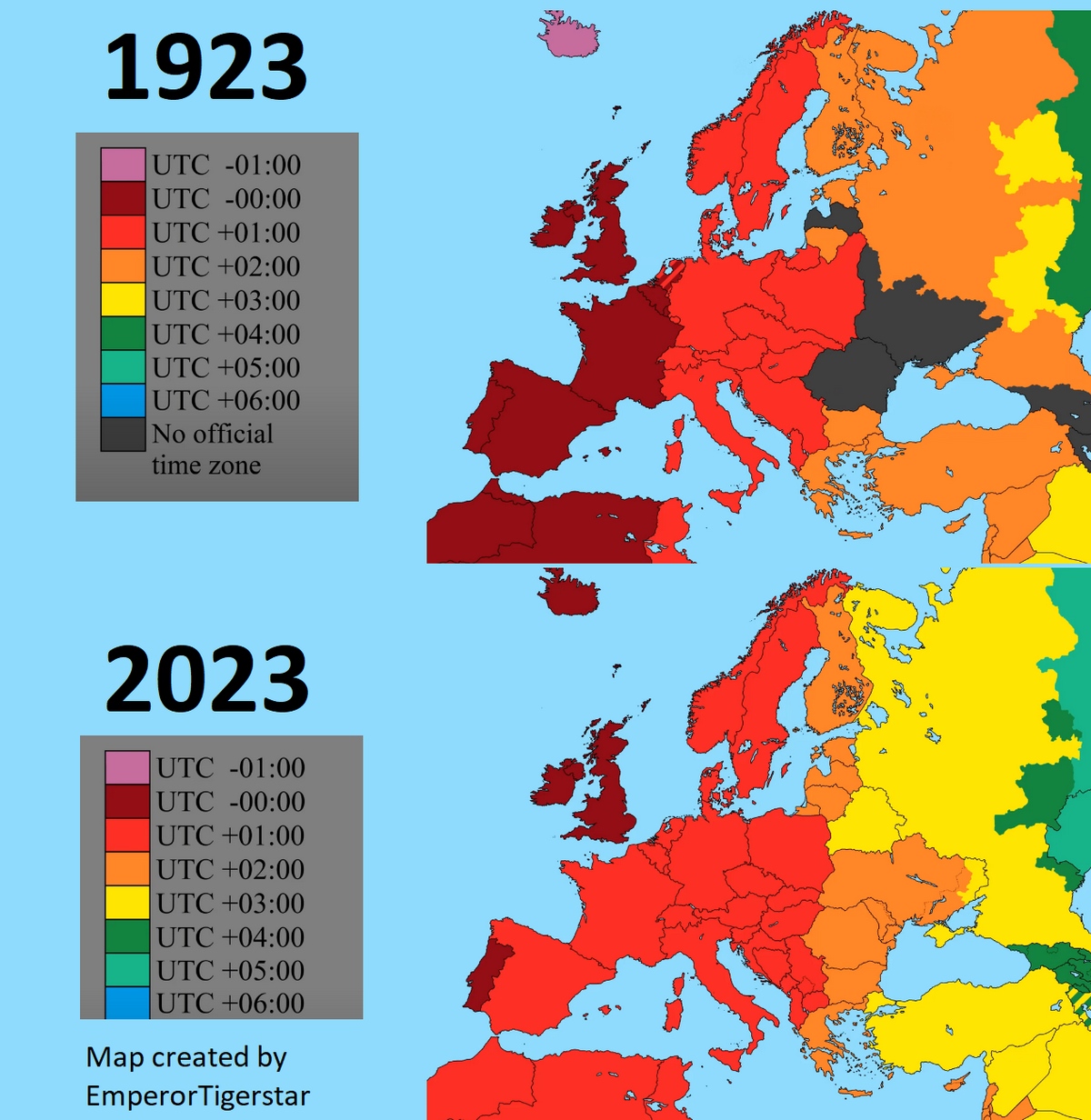
The old borders aligned with the sun a lot more, so we can blame that on WW2 as well.
It's not just a measure for the state of sun in the sky, it's also a measure for the state of society on the ground. It's an arbitrary number in a sense, but it also strongly influences my schedule.
And yes, we could have all the schools and everything else open later in the winter than the rest of the year, but it turns out it's easier to change the clocks.
But the school schedule does already shift and it shifts later, so in the opposite direction. The policy trend is going in the opposite of what you want to achieve with year-long DST, you could instead vote for the status quo and have the same effect.
Do BC schools have a different winter schedule? That's not how it is where I live, at least. It seems like it would be pretty annoying to have to reschedule activities around getting to/from school twice a year.
I can only comment on some parts in Germany, and no I don't know of different seasonal schedules. I meant that the general trend is for the school day to start later, so that the teenagers get more of their precious sleep. Year-long DST would get them to get up earlier again compared to the sun. This trend is the same for office hours and working shifts, they become later, since people just want to sleep longer. (Which is obviously bullocks.)
Farmers don't care about clocks, they do the work whenever needed. Roosters crow whenever they want. There's literally no point in talking about farmers in this debate.
> Humanity settled on these numbers long ago because they work best.
Absolutely not. It was a compromise tempered by practical and political considerations.
Sadly, this isn't really right. Humanity settled on solar time. For somewhat obvious reasons.
Alas, I don't see my preferred method of changing the clock by 10 minutes every month taking hold. Basically ever. :D
I also don't think this is nearly as important for places that are not further away from the equator. If you are on the equator, you are almost certainly fine with no change throughout the year.
That method wont work, that is a too large change that happens to seldom. What you want is a leap second every hour for five months to switch between standard and daylight savings time and back, with a month of constant time around each solstice. That gives you a smooth transition without perceptible discontinuities.
the reason was valid 50 years ago when most people didn't work 9-5 in front of a computer.
Yeah they started work at 6. So the working schedule shifted later by three hours, but with year-long DST it will shift back only one hour. Sounds like people don't actually want what they now vote for. My bet is that the work hours will just move later yet another hour in the future.
Meh. The nerd in me prefers the French Revolutionary clock of 10 hours in a day. https://en.wikipedia.org/wiki/Decimal_time.
I want to be able to say I sleep from 0 to 3 hours or 30 percent of the day.
And that reason was that it was the standard before the standard was rethought. There's no deeper meaning to it.
And we rethought it yet again, should we go on the time standard (DST) that we're already on for ~65% of the year, or the one we're on for ~35% the year.
It should be pretty obvious why DST is the new winner, it's the current standard.
Not that long ago, and we keep fiddling with them. The US time zones were adopted just over a century ago. The dates for daylight saving time were changed less than 20 years ago. Much of Western Europe changed time zones (much of it rather violently) in the 1940s, as did China. The tz database often requires updates for changes.
If you want to go with what was settled long ago, that would probably be a return to each town observing its own time based on local solar noon, which would be pretty annoying.
> I would have preferred permanent standard time to permanent daylight time.
Do you have children?
In past HN threads, the preference largely comes down to whether you have children (and want more early morning light for safer trips to school) or not.
I have children and I’ve never heard any arguments for DLS that make any sense.
Most of the time people conflate longer summer days with DLS.
The situation with dark mornings is winter not standard time.
My children are already waking to school in daylight this time of year prior to the switch to DLS.
As others have said. I would rather permanent standard time but I’ll take permanent DLS. Moving the clocks twice a year is insanity.
As far north as BC is winter just doesn't have enough daylight to think you can get everything done with sunlight. Maybe Arizona has enough - but they don't do daylight savings time (one of two us states)
> winter just doesn't have enough daylight to think you can get everything done with sunlight
That's the perfect way to say it.
The other piece that a lot of people are missing is the whole larks (early risers) vs owls (late risers) divide. I think the best illustration of that is to ask, if you got your pick, which shift you'd take, based solely on your own body and habits: 8-4, 9-5, or 10-6 (or perhaps even further in one direction)? My guess is that the answer to that question predicts your desire for Standard or Daylight time pretty well.
My guess is that both owls & larks get their preference logically backwards.
My guess is that owls will say they prefer permanent daylight time and larks will say they prefer permanent standard time.
But their revealed preference is the opposite -- owls wake up well after sunrise and go to bed well after sunset. Yet permanent daylight time will shift it so they'll be waking up closer to sunrise and going to bed closer to sunset.
Larks revealed preference is more like permanent daylight time yet I think they're more likely to say they want permanent standard time.
I'm definitely in the night owl camp and I'd much rather have sunlight in the mornings because I already am going to have trouble waking up each morning, making it so I can't even set my circadian rhythm properly is just adding insult to injury.
It amazes me that we actually argue about this based on vibes. We know that people are better off the closer the time between waking up and sunrise.
10-4 obviously.
Okay, yes, but not helpful here: that's a different thread.
I don’t have children, but I was a child once. I didn’t mind going to school in darkness (in winter) and enjoy 1h more of daylight in the evening. Having that extra hour of daylight in the morning always seemed a waste for me because I wasn’t doing something I wanted (I was doing something I had to do, this is, going to school)
When we had kids I thought daylight savings time was going to be some kind of nightmare because ever DST thread on the internet cites children as the reason why's it terrible.
Then it was a complete non-issue for our kids. I had this conversation with several parent friends and they couldn't figure it out either.
At most we've had a day or two where the kids wake up 10-20 minutes later than the target time, but it's not a big deal. Honestly it takes me longer to adapt than my kids.
I can believe that some kids are hyper sensitive to clock changes, but the more I talk to fellow parents I think it's a minority case. Traveling a couple states away is a bigger swing than DST.
I think this is a talking point that came up on the internet at one point and then got amplified because so many liked the direction it was going, but never stopped to think about how accurate the claim was.
Some people think that if their toddler misses naptime by 5 minutes it will be a disaster. Fairly sure it's just a vocal minority kind of thing. Totally with you though, our kids never seem to notice.
Where I live, in winter it's dark in the morning (and also the evening depending on the length of the school day) with and without DST, and in summer the sun is also up either way.
Conversely, I'd rather my kids have more daylight after school so they can explore outside.
Selfishly, I just want as much daylight as possible, which has very little to do with how a government selects a time range for legal reasons. The rotation of the globe has not been yet controlled, as far as I'm tracking.
As a child, there was nothing worse than getting out of school at 3pm and then having the sun set at 4:21pm. I barely got home before it got dark, forget about playing outside. Morning time was useless, since school prep ate that up.
Right? I literally never once cared if I have to walk/ride to school in the relative dark. But I did care pretty much every afternoon how much time I have to enjoy the rest of my free time. Being able to go out with my friends and enjoy the daylight made a huge difference. It's soooo long overdue to put this stupid system in the past.
I don't have children and I prefer permanent Standard Time because I have the apparently weird belief that noon should be at noon.
(i.e. the time 12:00PM should be when the sun is overhead)
I'm not a "capitalism gives you brain worms" kind of person, but the idea that it is somehow better to literally change the location of the sun in the sky because the holy hours of 9-5 are sacrosanct is so strange to me.
I lived once in Ecuador. Pretty much the whole year the sun rises at 6am and sets at 6pm. I very much prefer Spain: in summer the sun sets at almost 10 pm at its peak… best summers of my life. I lived in Poland once too, where in winter the sun sets at 3pm: I wanted to kill myself
I miss sunset times from Spain. It makes days feel longer
9-5 aren't sacrosanct. When the 9-5 song came out approximately nobody worked from 9-5. Standard working hours were 8-5 with an hour for lunch. Starting at 7 was far more common than starting at 9.
The song is about a secretary who didn't get a lunch hour, so started an hour later than her boss.
Tech workers generally start at 9, but that started decades after the song came out.
> because I have the apparently weird belief that noon should be at noon
But why? Because it's not even in standard time, except for around 1/60th of a time zone at best, if you're rounding to the minute.
If solar noon jumps from being at 11:35 in standard time, to at 12:35 under DST, at your coordinates, what does that matter?
Noon was at noon before the railroads. But ever since time zones were invented, that's no longer been the case.
Digits on a clock are just a number. If you care about when solar noon is, just memorize it.
Almost nowhere do you see the sun directly overhead at noon, even during Standard Time. The differences can be quite stark: https://24timezones.com/cms-static/images/uploads/solartimev...
BC (and PST) is actually quite reasonable in this regard, with Vancouver and LA being fairly close to "on the money." Contrast that with China and Russia, where clock time can be 2h+ off from solar time.
As a further note, this is one reason it's miserable to be in Boston/Maine during the winter if you're an SAD sufferer: sunset times of 4pm or sooner feel like "insult to injury."
Maybe, but Standard time is still closer to "correct."
"Daylight Savings" time never made sense. Why are we "saving daylight" when there's more of it?
> Why are we "saving daylight" when there's more of it?
We're saving it from the morning in the summer, when there's way too much of it while we're asleep, to use it in the evening, when we want to enjoy the outdoors with our families and friends after dinner.
The point is to increase the enjoyment of summer sunlight after the work day is over.
No, the point was to conserve fuel for the winter months. Which was why dst was a wwi directive that was abandoned after the war. We reimplemented it during wwii and just never changed back
I'm talking about the modern rationale, not the historical one.
Also, no, it wasn't to conserve fuel for the winter. It was to conserve fuel during the summer so it could be used in the war, also during the summer.
But it's not like we forgot to change back. It's that we decided we really liked the longer usable daylight in the summer. There have been tons of adjustments to DST since WWII, reflecting the fact that we like it in the summer, and have variously adjusted which months it covers.
The point is, it is literally described as saving daylight, which is what I explained. "Saving" it in the morning to use in the evening. The "saving" in the name always referred to daylight, not to fuel.
Save it in the evening, it was always dark in the morning.
Historically we were saving daylight for the morning
tangentially related, Dr. Andrew Huberman shared a video in which he asserts that exposing one's eyes to sunlight very soon after waking is "good for your brain" (essentially): https://www.youtube.com/watch?v=h2aWYjSA1Jc
https://grok.com/share/c2hhcmQtMi1jb3B5_f52a6bb5-dc0d-4a3a-8...
Multiple peer-reviewed studies and analyses indicate an increase in traffic accidents—particularly fatal ones—following the spring transition to DST. This is often attributed to acute sleep deprivation (losing one hour of sleep), circadian rhythm disruption, and altered light conditions during peak commuting hours, which can impair alertness, reaction times, and visibility. Key findings include:
A large-scale U.S. study analyzing over 732,000 fatal motor vehicle accidents from 1996 to 2017 (published in Current Biology, 2020) reported a consistent 6% increase in fatal crash risk during the workweek immediately following the spring DST transition, equating to approximately 28 additional deaths annually in the U.S. The effect was more pronounced in western regions of time zones and persisted into afternoon hours despite longer evening daylight. Other research has documented short-term spikes, such as increases of 16% on the first day and 12% on the second day after the spring change in some analyses, or broader elevations in fatal crashes linked to the "DST effect." Systematic reviews and meta-analyses confirm short-term elevations in collision risk post-spring transition in many (though not all) contexts, with some evidence of higher fatal accident rates in the U.S. specifically.
The fall transition back to Standard Time shows more mixed or opposite patterns: some studies report small increases in certain crash types (e.g., due to darker evening commutes increasing pedestrian or deer-vehicle collisions), while others note decreases in vehicle-occupant fatalities or no net increase overall. A 2017 systematic review of road traffic collision risk found inconsistent short-term effects across studies (some showing increases, decreases, or no change), but long-term analyses often suggested a net safety benefit from DST periods due to evening light. Recent Insurance Institute for Highway Safety (IIHS) research (covering 2010–2019 U.S. data) indicated that spring DST increases fatal motor-vehicle occupant crashes (+12% in the following five weeks) but decreases fatal pedestrian/bicyclist crashes (−24%), resulting in a near-neutral net effect on total fatal crashes (slight increase in occupant deaths offset by fewer pedestrian/cyclist deaths). In summary, your memory is correct in that empirical data—particularly from U.S.-based studies—support an increase in traffic accident frequency (especially fatal crashes) associated with Daylight Saving Time variations, most reliably in the immediate aftermath of the spring transition due to sleep loss and misalignment. However, effects are not uniform across all studies, regions, or crash types, and some research highlights trade-offs (e.g., benefits to pedestrians from evening light). Debates continue regarding permanent DST, permanent Standard Time, or abolition of changes altogether, with organizations like the American Academy of Sleep Medicine favoring permanent Standard Time to minimize disruptions.
Ultimately the arguments between whether one should pick daylight or standard times are a red herring.
The benefits of one over the other usually balance out and in either case are insignificant compared to the problems caused by changing time zones twice a year.
Changing time zones is directly linked with all sorts of health issues, deaths, car crashes, etc.
"Pacific time" is going to be so confusing though. Should have just called it Yukon Standard Time, since that's already a thing, at least informally. Cause that would not be confusing at all...
> "Pacific time" is going to be so confusing
It’s already ambiguous. Just use a city and let your calendar do the rest. New York, Phoenix and San Francisco time are unambiguous in a way trying to name time zones is not.
Yes, it's going to cause a lot of confusion and missed meetings. At the moment everyone says "pacific time", but now that will mean two different things.
I think we'll need to say Vancouver time or California time.
Maybe people will finally learn the difference between PST and PDT.
They won't.
In my professional experience, having needed to work with relatively unsophisticated people across many time zones, the only thing that worked consistently was "[City] time". That way people could always check 'what time is it in X now' or 'when it's X in [City], what time is it here', and get correct responses.
Descriptors like "Mountain time" are too vague, especially when there are various places that do/do not practice DST within that timezone, or there are similarly named time zones internationally. (Australia has Eastern and Central time too, for example, and in summer - which is northern hemisphere winter - they split into four different time zones due to varying DST practices.)
Trying to be overly clever and exactly specify the time zone, e.g. "MDT", leads to lots of subtle mistakes in my experience. Often people will think they know what that is, and then get it wrong. Or their calendar app will helpfully suggest MST and they'll click on it, not noticing the difference. Or they'll just scramble the letters when writing them down and wind up with "NTT time" or "AT&T time" or some such.
Mountain time is ambiguous due to Arizona, and yet we still use that phrase. Hawaii-Aleutian time is also ambiguous: the Aleutian islands do daylight savings, but Hawaii doesn't.
Casual speech doesn't use the city names (like America/Los_Angeles for pacific time); presumably we'd have Pacific time (America/Los_Angeles) and BC time (an update of the existing America/Vancouver). If Washington's time change ever gets approved it would presumably become simply Washington time (America/Seattle maybe?).
My dream world is everyone using 24 hour clocks set to UTC
My dream world would have 86400 time zones, one per arc-second of the globe, so we can all sync our clocks at high noon.
My favorite depiction of your dream world: https://qntm.org/abolish
> Uncle Steve is zero hours ahead.
Uncle Steve is the same number of hours ahead that he has always been, and that's a thing that could be looked up just as easily as finding his time zone. I think the author is greatly exaggerating the degree to which time zones solve any of the problems mentioned. Uncle Steve might be on a different sleep schedule from me, regardless of whether or not he's in a different time zone.
Days of the week definitely become interesting in a global UTC system, but noon used to literally mean "the sun is at it's highest point". I suspect that people would grumble for a year or two and then forget that another system ever existed.
There's certainly a bit of dramatization/exaggeration here, but the main point is that it doesn't really fix the stated problem while also being a huge change for everyone to adapt to.
I feel like days are a non-issue; they would just start at different times (UTC) in different territories. This wouldn't make things any more complicated than they already are (currently, if I want to talk to someone in Australia, I have to look up what time it is in Australia and infer the day of the week from that, if necessary. If everything is under UTC, I know what "time" it is, but I still have to look up what day it is).
Most of the issues time zones cause are not "day of the week" related anyways (at least in my experience), so I think having to figure out what day of the week it is somewhere else wouldn't be a common problem anyways.
I think you missed entire point of operation.
If everywhere runs on UTC, they will still have different times when people are working/not working/sleeping so you still have to look something up and figure it out.
With time zones, you look up "What time is it?", realize it's 4:30AM and since most people around the world follow similar schedule, you quickly realize he's fast asleep.
tbh I think a more realistic depiction would be:
Before UTC4ALL: is UB awake? what time zone is UB in? idk, what zone is Melbourne? +11? uh... carry the one... 6:25, maybe a bit early, let's try in an hour[1].
After: is UB awake? he said gets up at 13:30, so call in a couple hours.
You want to call someone, but you don't know when they're available? Maybe you should ask them, so they can tell you it's 13:30 to 4:00, with zero "is that my time or your time" worries. Or check your shared location-aware calendar, which already handles both cases equally well.
How often do you do several-thousand-mile phone calls without knowing anything about the recipient's schedule? Where I come from that's gonna be rude, send an async message instead.
1: yes, the math/calculated time is wrong. on purpose. as an example.
thank you for sharing, I was trying to find something similar that explains why UTC everywhere is such a bad idea!
My dream world is we apply time zone logic to every other unit of measurement.
1 metre can be 100cm or 200cm depending on the season and your location
My nightmare world would be one where we apply "everything else" logic to time.
1 kilosecond: about 17 minutes
1 megasecond: about 12 days
1 gigasecond: about 32 years
"Oh man, it's been a hot megasecond since we last spoke!" Said everyone, in my worst nightmares.
12 oz of alcohol would obviously be larger in the winter the closer you get to the poles. I think I like this idea.
And then it's going to be so fun guessing at which time each country in the world starts working
Not hard, visualize the locations on the globe and a pie with 24 slices. If you start work at 12, and you want to know when someone 2 slices West will start you add 2 to get 14. 2 slice East of you, subtract 2 to get 10.
Better than guessing what timezone the region picked when it spans multiple natural time zones, and whether they do or don't have time changes.
Also it's much easier for communication, because if someone sends you a message asking to have a call or meeting at X hour there's no need to know their timezone, because your X hour is the same as theirs no matter where you are in the world.
Mine too. People seem to have are hard time conceptualizing the hour as an arbitrary number, rather than having a static (usually incorrect) meaning associated with it like 12 as noon/midnight.
Time zones are a pain, but it might be too much to fix.
Now, 13 month calendar with each month 4 weeks, on the other hand..
But if we abolish time zones how will we keep trains from hitting each other on the tracks?
Sounds good on paper, terrible idea in practice.
Nah, it also sounds terrible on paper.
I'll correct myself: it sounds good for about 5 seconds before you think about it and realize it's an unworkable idea which creates more problems than it solves.
I will readily admit that I'm an idiot, but I've thought about it for literally multiple minutes, and I still love it. It even still seems workable!
I have all my clocks set to UTC. Works for me
I also did that for some time, I just don't perceived clocks to have a single point that is up and mentally rotated clocks all the time. The hours just lost their meaning beyond their numerical value.
Good for you. I am currently living in Japan, and I don't want sunrise to happen at 21:00, noon at 3:00, and sunset at 9:00.
Here's the IANA time zone mailing list thread where this is being discussed:
https://lists.iana.org/hyperkitty/list/tz@iana.org/thread/66...
Bad timing on BC's part. They just tagged release 2026a today.
Eh, they're still keeping the impending switch to PDT, just ditching the future switch back to PST (and all future changes). That should give around 7-8 months for a new timezone file update to percolate.
I went looking for a visualization tool to help get a sense of what this change means experientially. Found this:
This will never not feel insane to me, it's just because no one wants to say "move classes and work an hour later on [x date]". Somehow changing noon away from noon is a better answer.
It's worth noting that in China, where the whole country is on a single timezone (which is roughly solar time in the eastern part, but far from it in the western part), places in the west simply have a different notion of time.
> China, where the whole country is on a single timezone
Relevant Negativland? https://www.youtube.com/watch?v=QDmWYVdN8ug
It would be great to see Europe adopt it as well. Changing clocks twice a year feels outdated and more disruptive than beneficial.
Absolutely not. The time that would stay is the bad one.
With switch, we get reasonable half a years. Without it, it would be whole unreasonable year.
The biggest unreasonability is switching at all. I admit other points of view, but switching back and forth is a compromise that seems far worse than just sticking with one. Either one.
We seem to be in the worst situation now where not only does the EU change their time twice a year, they change it on a different schedule than US/Canada.
For a few weeks during the year, half of your meetings start at a different time. Everyone is confused.
Now add southern hemisphere
I am so jealous. I hope the entire West Coast can follow this example.
Indeed. Very much hoping WA hops on board. I know we stalled after 2019 but I wish we'd just hop on board.
Everyone else is throwing in there 2¢, so here's my pet proposal.
Here's the undeniable fact: everyone (ok, almost everyone, but it's a rounding error) hates the switchover in spring, when you have to get up an hour earlier. Conversely, everyone (or a rough approximation) likes the switchover in the fall, when we get to sleep in an extra hour. So why don't we just get rid of the switchover in the spring and get rid of the one in the fall?
So maybe make the day a bit shorter, same 24 hours same 60 minutes, just shorter by a few seconds, so that we can add an extra hour every quarter.
I vote we sleep in an extra hour for BOTH time changes
Now that's a win-win
I hate both. The time jump in fall means sunset starts happening depressingly early (almost exactly 5pm where I am, which means no sunlight after work).
that's a load of horseshit. everyone around me want's the daylight savings time, to have more light after work. nobody cares about mornings.
> when you have to get up an hour earlier
no you don't. it's weekend.
Wow we finally did it
I won't complain about the NDP for at least 3 days after this one. This is cause for celebration!
Even a stopped clock is right twice a day!
Another falsehood programmers believe about time. A stopped clock is only right twice a day if it is a 12 hour clock and only if it’s not set at a leap second or at a skipped time during the shift from standard to daylight time.
I was being generous. Which wasn't really justified considering Eby's track record.
At least he has a decent housing minister
Not all of British Columbia can make the change. BC's northeast and much of the Columbia-Kootenays are presently on Mountain time, which means that the Province of Alberta holds the choice of when/whether their own and those BC areas go to a permanent time. Then AB would have to sync with Saskatchewan along their borders, but SK is already on a permanent time zone system. Decisions, decisions.
The northeast is already on permanent PDT.
On further reading, the northeast of British Columbia is on permanent Mountain Standard Time, as seen here:
https://www.timeanddate.com/time/zone/canada/chetwynd
Parts of the Columbia-Kootenays change between Mountain Standard and Mountain Daylight time:
https://www.timeanddate.com/time/zone/canada/cranbrook
while the Town Of Creston is permanently on Mountain Standard Time.
This is the best possible choice. I hope everywhere follows suit.
A few years ago I was against changing the time but now I tend to even suggest a full two hour change! In the developed northern hemisphere the summer/winter daylight difference is huge (about 2 hours in the morning and 2 in the night) with a short time of equal length. Maximizing sunlight exposure while the people are outside is vital, mainly for psychological purposes. That means let the light begin at about 7-8 all year long and let summer afternoon extend as much as possible. No kid leaves home before 8 and the 6-in-the-morning drivers will pay attention all year long and not only during the winter. But all types of people will enjoy the long summer afternoons.
In germany the terms are Sommerzeit (summer time) and Winterzeit (winter time). Of course everybody would chose the former as summer sound better than winter but the latter is "better" as it corresponds more to "wake up when there is light" which is favorable to health, performance etc.
The report linked in the article has BC support _massively_ in favour of "more light in the evenings" instead of "wake up when there is light", citing health and wellness concerns. "Better" seems a matter of opinion.
That's a very dishonest take, as I'm sure you know that Sommerzeit proponents have reasons other than "summer sounds better than winter".
For example most people just wake up and go to work in the morning, but in the evening they meet friends, BBQ, hike/run through nature, do sports etc., and prefer doing those activities while it's bright outside.
What stops you from going to work one hour early, so you get off earlier as well? Most employers these days allow flexible working hours.
And if we are permanently moving our clocks to advance by an hour, why stop at just one hour? Why not have +2h or +3h so we get even more brighter evenings.
Because most people don’t have that degree of flexibility. When I was commuting I’d have been happy to have double DST or whatever you want to call it.
"Most employers" definitely don't allow flexible working hours. You have to be in specific sectors – basically just "modern" tech companies – to have that privilege. And that is a very tiny slice of the working population.
With flexible working hours it works in both directions, so @ndr42 can also wake up an hour later for his health and performance :)
Im very healthy and performant during sommerzeit. It’s in winterzeit when I get depressed bc there isn’t enough daylight in the evenings (it gets dark around 3pm-4pm in winter… that sucks big time)
How exactly do I fix the backend after this? Will a newer version of php or nodeJS have the correct handling of these timezone changes? I’ve been wondering about this for a while but can’t find an answer when googling.
The new rules will be incorporated into tzdata, which is used for various operating systems, software libraries, etc.
Not sure why you're getting downvoted. When I read the headline, my first thought was "how are they going to update the tz database on all Linuxes in the world in time?" I expect some confusion on November 1.
Here's the thread on IANA time zone mailing list where this is being discussed: https://lists.iana.org/hyperkitty/list/tz@iana.org/thread/66...
BC should've timed this better. They just released 2026a.
In the future, you can check if your database has been updated with this: (it should show no transition in November):
zdump -v America/Vancouver | grep 2026I fully support removing DST (as a parent at least, it's a PITA twice a year).
However, clocks should show noon correctly, as best as they can within your chosen timezone. Also, I really like long evenings in the summer to get outdoors and go biking or hiking. It follows that we should abolish DST, stick to the correct time, and move regular school and business hours back one hour.
Good luck coordinating that.
School and business hours are already fairly arbitrary where I live. The only places observing "standard" hours seem to be banks and even many of those stay open later in the evening these days. Meanwhile the schools do everything based on juggling a limited number of busses meaning that start and end times are staggered over a period of 3+ hours. You see evidence of this in traffic patterns as well. It starts early with the trades and runs well into the late morning due (AFAIK) to tech.
I'll genuinely miss it getting dark at 4PM. Winter won't be the same.
what does "daylight time" mean?
is it summer time or winter time?
https://en.wikipedia.org/wiki/Daylight_saving_time
Probably, "summer time"; it means the +n hour change in offset (usually +1h) that some timezones jump into in the spring, and remove in the fall.
This zone is making DST "permanent" (subject to future legislation).
Most people agree that changing the clock twice a year is silly, for obvious reasons. Still, there's a small minority that thinks that the existing system is good, for obvious reasons. Among those who want to abolish time zone change, there's roughly 50/50 split between those who prefer permanent summer time for obvious reasons, and those who prefer permanent winter time for obvious reasons. There are a few more exotic ideas floating around - many of which are obviously better than any of mainstream ones, but they unfortunately have a low chance of being adopted.
The end result is probably going to be more and more fracture on local level, as smal units of administration adopt their favorite solutions. This is obviously bad for doing business between units of administration, and obviously good for circadian rhythms of the people living within given unit. One thing obviously has more importance than the other.
FInally!
Especially living that far north, they're going to find out next winter why we do the whole DST thing. It seems to be something like the Measles vaccine where you just have to have a big outbreak every once in a while so that the cultural memory is refreshed.
They picked wrong.
They should have picked Standard Time.
As someone else pointed everyone is already on DST for approximately 65% of the year. This just removes the remaining 35%. Picking standard time would have been a much bigger change.
Ultimately, it's entirely arbitrary anyway. The only issue is that American states cannot pick DST without a federal law change.
> As someone else pointed everyone is already on DST for approximately 65% of the year. This just removes the remaining 35%. Picking standard time would have been a much bigger change.
This 65% started during the Dubya presidency (source: I was there updating tzdata on systems), and previous to that it was a 50/50 split.
So 65/35 or 50/50 is arbitrary.
But the reasoning for that was a preference for DST.
Obviously all this is arbitrary including standard time.
> But the reasoning for that was a preference for DST.
There was no reasoning for the Dubya alteration: the change was not debated anywhere, and (AIUI) no one was ever able to figure out how it actually got slipped into the legislation.
The DST extension was included in Section 110 of the 2005 Energy Policy Act, debated as part of the bill, and justified on energy-savings grounds. Congress even required the Department of Energy to study its impact afterwards!
Metric time would have been better.
So they chose the wrong way. Nice.
[dead]
[dead]
[dead]
<Insert Archer WOOOOO video>
Seriously, woo!
Reminder that a few hundred years ago when clocks were oddities we didn't have to deal with any of this madness because everybody used True Solar Time as a sundial would read it. What time do kids go to school? After the sun rises. Simple. Now that we have clocks it suddenly becomes difficult to schedule simple things like sending kids to school in sunlight.
While true, I'm not sure what your point is? Centuries ago, everyone got up at sunrise to tend to the farm because the farm needed tending at sunrise. These days, organizations like schools and grocery stores need to coordinate with hundreds to thousands of people daily, and "angle of sun in the sky" is nowhere near precise enough. Let alone phone calls and instant messages that travel across many timezones.
I'm merely saying that the mass adoption of clock time for planning daily routines was an industrialist conspiracy to get people working when by natural right they should be sleeping.
We could easily have software presenting time to us as true solar time. We're not limited to gears and levers anymore, our "clocks" now have GPS and can trivially calculate solar time with that. Doing this one off is easy. The problem is society at large still trying to make plans like when to start work shifts or school hours based on a system of time that flies wildly out of synch with Earth's natural rhythms throughout the year.
Massive self-own for humanity.
I think point is that now we have technology that is super adaptive to local longitude while changing timezone in all of worlds software is super difficult.
Once we invented the railway we quickly realised that Oxford Time and London Time being 6 minutes out was not helpful. That was 180 years ago.
This question IMO reveals how the abstraction of numbers can imprison our minds.
It literally makes no sense to say, "I prefer to have an extra hour in the evening" (the morning and evening will always have equal numbers of hours). Or "I hate it when it's dark at 5pm" (translation: "I hate when it's dark at 5 arbitrary periods after an arbitrary moment that may be hours either side of solar noon").
My solution: pick the time peg closest to the "correct" one (i.e. standard time) and stick to it. People who want year-round "summer" evenings can continue to have them by the simple expedient of doing what DST forces them (and everyone else) to do already: get up earlier.
In a world where there isn't work schedule and in general the whole of society's schedule which works around the arbitrary time, I agree with you.
Sure. But this argument is surely less powerful than it was back in the era of church bells and big clocks on factory walls and so on. We now have electronics that add a whole new layer of abstraction to our schedules, to the point that you can now miss a DST change if you're not paying attention. For many people (I'm one) this change is now just a useless irritation.
So adjust the work schedule.
If people want more time in the evening, get up earlier and go to work and go home earlier.
You can even shift school/work schedules throughout the year.
The work schedule is adjusting all the time, and it moves in the opposite direction.
It makes sense when schedules are fixed and time is the only thing we can change. I wouldn't mind switching to standard time if I can change my work schedule to have more light after work. I work from home, I don't care about not having light in the morning
> This question IMO reveals how the abstraction of numbers can imprison our minds.
Is it the abstraction of number that imprison our mind or just the reality of having a job and other social constraint based on all of us agreeing on a time?
When most people can’t leave their job before 5pm, wether it’s dark at 5 or 6 makes a huge difference.
The social construct is moving later though. I guess this is because people's desire to sleep longer is making them move the social constraint of being at work later, while they stay up "partying" regardless of the social constraint.