by shagie 10 hours ago
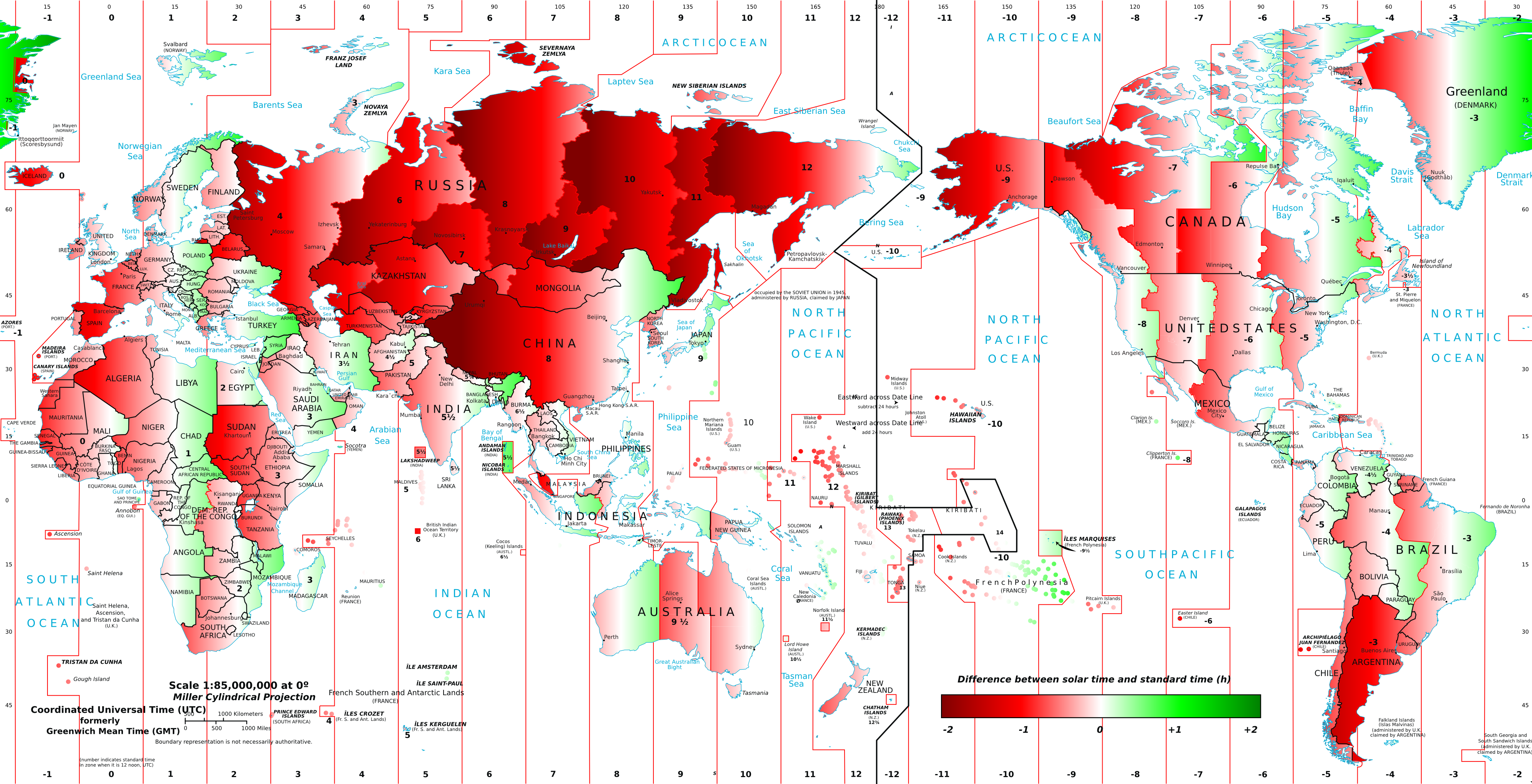
That's partly because it's in the same timezone as Poland. Madrid is further west that London, but London is an hour behind. Moving Spain to permanent DST puts it on the same effective timezone as London.
http://blog.poormansmath.net/images/SolarTimeVsStandardTime....
Without the DST offset, Spain much more "red" than England.
It's not so much a "permeant DST" but rather a "we want to change to GMT without moving out of the CET timezone."
In Poland in winter it gets dark around 3 PM. Awful. In Spain in winter it gets dark around 5:45 pm. And people wonder why spaniards live longer.
The clocks should show 4:45PM in Spain if the TZ was right (same as UK), and even so it would still be mostly red-white with barely any green. Poland appears white-green in the map, to have a bit of red it should be in a 1/2 TZ like India.
Minimum daylight (winter) in Warsaw is 7h 42m [0] and in Madrid 9h 17m [1]. Maximum (summer) is 16h 47m and 15h 4m. That is due to latitude and unavoidable. The exact numbers for sunset and sunrise are pushed around by the TZ choices.
[0] https://www.timeanddate.com/sun/poland/warsaw
[1] https://www.timeanddate.com/sun/spain/madrid
Life lenght depends on many factors.
That map is interesting, so most of the world prefers "red" to "green"? Why is that?
Most of the world tends to prefer to not be too far from the center of the timezone (where solar noon matches solar time in standard time). Geographic and political boundaries make it so that often it's more red. The extremes of north and south tend not to care as much because it doesn't matter as much.
https://andywoodruff.com/blog/where-to-hate-daylight-saving-...
I don't think that explains it. The "red" offenders are basically Russia, China?, Sudan, Argentina and Alaska. The only "green" offender is Greenland, which is still large enough to enough red to justify it. I get China, it aligns with the population density. Sudan likely wants to have the same time as Somalia and Ethiopia. Why Argentina? Why Alaska? And why does Russia basically have zones that range from +2 to the +1 offset? They don't even have the excuse of avoiding 2 hour jumps like between Alaska and Canada, because they still have that.
I'd have to dig to try to find out what the date on this would be.
Russia is telling since they changed their timezones in 2016. I'm going to note that timezones are also a political identity too. https://www.timeanddate.com/news/time/russia-new-time-zones.... For a map https://commons.wikimedia.org/wiki/File:Difference_between_l... and the Wiki article https://en.wikipedia.org/wiki/Time_in_Russia#Russian_Federat...
China is aligned with Beijing and the rest of the country follows from when noon in Beijing is.
Sudan's history is in https://en.wikipedia.org/wiki/Time_in_Sudan
Argentina is https://en.wikipedia.org/wiki/Time_in_Argentina - My speculation would be that Argentina (the east coast especially) wanted to be economically synchronized with the coastal cities of eastern Brazil. Buenos Aires and São Paulo being on the same timezone makes it easier for the two of them to do business.
Alaska used to have four timezones. In 1983, they were consolidated into two timezones - Aleutian and Alaska. Being in -9 rather than -10 brings Anchorage closer to the Pacific west coast in its business day with the note that it doesn't matter too much when solar noon is if sun is up for 22 hours or 5 hours.