by ternus 11 hours ago
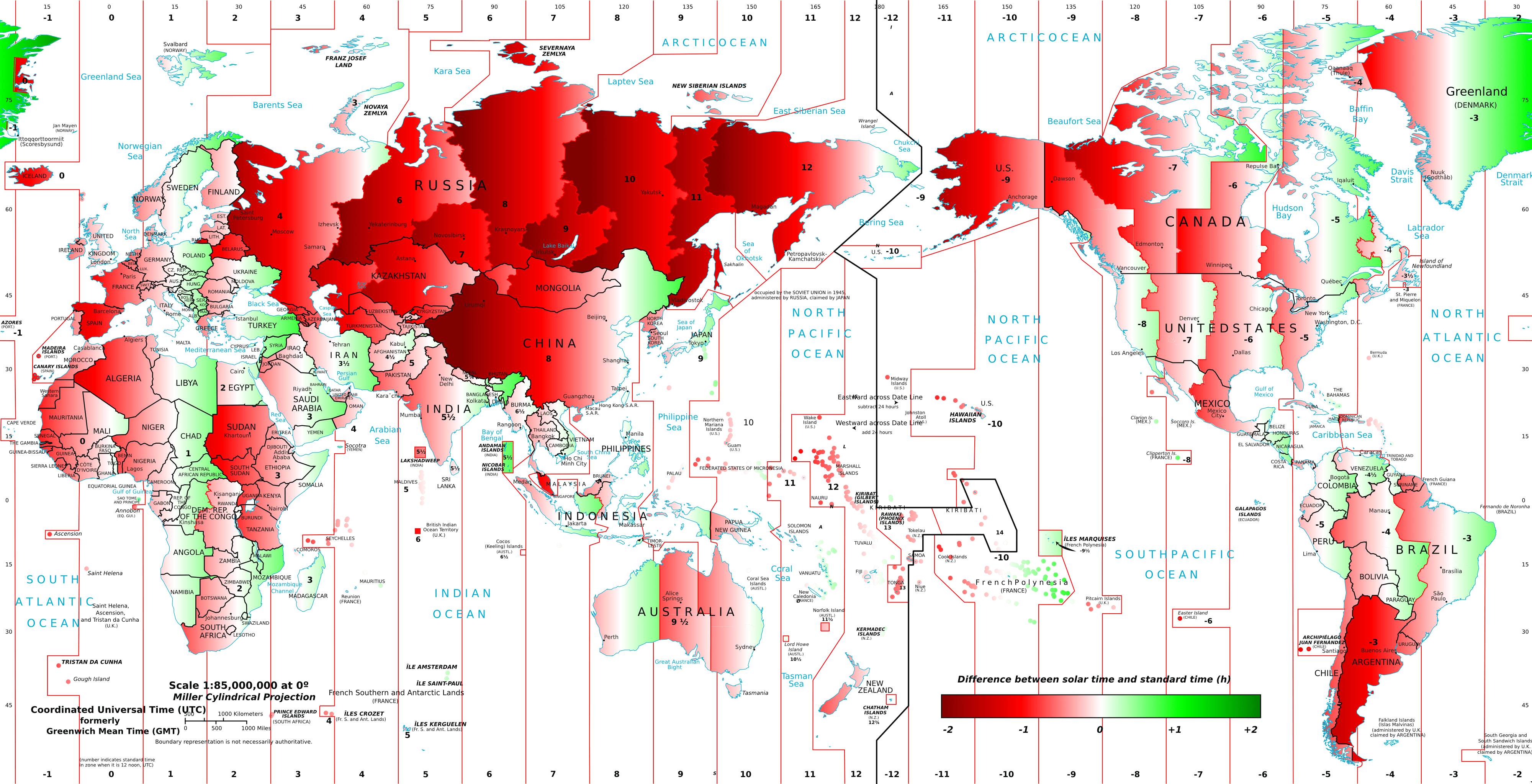
Almost nowhere do you see the sun directly overhead at noon, even during Standard Time. The differences can be quite stark: https://24timezones.com/cms-static/images/uploads/solartimev...
BC (and PST) is actually quite reasonable in this regard, with Vancouver and LA being fairly close to "on the money." Contrast that with China and Russia, where clock time can be 2h+ off from solar time.
As a further note, this is one reason it's miserable to be in Boston/Maine during the winter if you're an SAD sufferer: sunset times of 4pm or sooner feel like "insult to injury."
In Western Europe this is also quite pronounced.
In Białystok, Poland, solar noon is at 11:39. In Vigo, Spain, it's at 13:46, .
Being in favor of all-year DST (more sun in the evening is just nice), nice to see that those lucky Spaniards already have it and then some.
Whatever the preference for the permanent time, abandoning the switching should be advocated by the software industry. I've yet to work at a company where there are no bugs related to switching the clock. Those bugs have ranged from harmless to pretty severe.
That sounds like an unnecessary EU standardization. Having the same timezone in Poland and Spain possibly made sense 30 years ago, but now that all communication goes through computers of one kind or another, time conversion is seamless.
For those companies that have offices in both countries, and for which the synchronicity matters, it is not that difficult to just have special office hours.
Maybe, but Standard time is still closer to "correct."
"Daylight Savings" time never made sense. Why are we "saving daylight" when there's more of it?
> Why are we "saving daylight" when there's more of it?
We're saving it from the morning in the summer, when there's way too much of it while we're asleep, to use it in the evening, when we want to enjoy the outdoors with our families and friends after dinner.
The point is to increase the enjoyment of summer sunlight after the work day is over.
No, the point was to conserve fuel for the winter months. Which was why dst was a wwi directive that was abandoned after the war. We reimplemented it during wwii and just never changed back
I'm talking about the modern rationale, not the historical one.
Also, no, it wasn't to conserve fuel for the winter. It was to conserve fuel during the summer so it could be used in the war, also during the summer.
But it's not like we forgot to change back. It's that we decided we really liked the longer usable daylight in the summer. There have been tons of adjustments to DST since WWII, reflecting the fact that we like it in the summer, and have variously adjusted which months it covers.
The point is, it is literally described as saving daylight, which is what I explained. "Saving" it in the morning to use in the evening. The "saving" in the name always referred to daylight, not to fuel.
Save it in the evening, it was always dark in the morning.
Historically we were saving daylight for the morning